Gao 皋: The “God” of the 5th Month and Its Defining Relevance for Heart Function in Chinese Medicine

By Heiner Fruehauf According to the principal investigator’s expanded version of the Han dynasty cosmograph, ancient Chinese scientists associated the Heart network with the 5th lunar month of the year. The Erya encyclopedia (fl. 3rd century B.C.E) contains an enigmatic list of ancient designations for the twelve months, which the Japanese sinologist Hayashi Minao believed to be the names of twelve month gods.[i] In this book, the name of the 5th month is listed as Gao 皋. This character has a variety of complex meanings, which upon careful examination reveal an intricate web of relationships that tell a rich and coherent story all in itself. This story greatly illuminates the functional role of the heart network, which is presented only in rudimentary fashion in the medical classics.

Painting by Wang Hui, The Landscape of Mt. Song (17th century), The Cleveland Museum of Art.

The primary meaning of Gao is “high and lofty,” and Han chroniclers used it almost exclusively to designate places or persona of imperial rank. Several sources relate it directly to Mt. Song, the central one among the five sacred mountains of Daoist geography, which features prominently in both the mythology and archeological record of ancient China. Mt. Song is a cluster of mountains in the vicinity of the well-known Shaolin Monastery in today’s Henan Province, primarily comprised of Mt. Chonggao (“High and Lofty”) at the center, and Mt. Shaoshi and Mt. Taishi to either side. More specifically, Gao can be interpreted as the name of a pair of three-headed protector spirits of this mountain range, where sacrifices in honor of the mountain deities have been performed since prehistoric times.[ii] According to the Shuowen jiezi dictionary (100 C.E.), furthermore, gao means “to ritually invoke (the spirits of the gods and/or ancestors)”—in essence, to pray (a related homonym is gao 告, “to communicate with,” or “to ask for grace from a higher source”).[iii] This interpretation is confirmed by the fact that Mt. Song is one of China’s oldest natural “altars,” where archeological finds have recently confirmed that sacrifices were performed here as early as 5,000 years ago. For the ancient Chinese, therefore, this was the quintessential place where humanity ritually ascended to connect with the realms of spirit. As the Jiaoshi yilin (2nd century B.C.E.) states: “In the region of the City of the Sun and Mount Taishi, this is where the Manifest Spirit [shenming] resides.”[iv]

This theme of prayer, sacrifice, and connection to the spirit world is continued in the symbolism of the first three “cyclically appearing phenomena of the natural world” (wuhou) associated with the 5th month in the Liji and other early texts, namely “the praying mantis is born, the shrike begins to cry, and the bull-headed shrike ceases to sing.”[v] The body posture of mantis religiosa, or tanglang 螳螂 (“Officer of the Sacrificial Hall”) in Chinese, make it an obvious candidate for symbolizing the human characteristic of honoring creation through ritual gratitude. All three animals, moreover, are notorious creatures of prey, involved in the business of constant “sacrifice.” All three of them, furthermore, are sources of recognized medicinal substances in the Chinese materia medica (mantis cocoon, mantis body, shrike feathers, bull-headed shrike meat). Fittingly, they were categorized as substances said to exert a calming influence on the heart network.[vi]

Some time during the late Zhou and early Han dynasties, the early ceremony of worshipping the nature spirits became personified in the cult of Houtu 后土 (Earth Deity, Mother Nature). In China’s most distant past, most inhabitants of the central plains belonged to matrilinear tribes, and sacrifices to the Earth spirits appear to precede the worship of Heaven. The Earth Deity, alternately called Dizhi (Respected Earth Spirit), was thought to reside in the center of the ancient world (Mt. Song). During Zhou times, the central “nature altar” of Mt. Song was replicated in the institution of the ancestral temple and the various rituals of the dynastic state cult. While the Heavenly Spirit, addressed as Imperial Lord Supreme One, was pictured to reside in the highest level of the temple compound, the so-called Mingtang (Hall of Brightness), the central portion of the temple was occupied by Houtu Gong (Palace of the Earth Deity). It was here that the age-old rituals involving Mother Nature continued in institutionalized form. It was by design that these rituals were executed during the central temporal peak of the year, the time of the summer solstice that occurred in the middle of the 5th lunar month. This correlation is further corroborated by the tidal hexagram 44 (Gou 姤), which was often used to represent the energetic momentum of the 5th month during Han times. Gou is usually translated as connection, unity, or intercourse, but a rendering of the single components of this character simply yields the meaning: “The Queen.”

Houtu was regarded as the mother deity of nature, and an expression of its radiant life force and beauty–all compassionate, ever present. Mt. Song, therefore, was clearly regarded by the ancient Chinese as the place where spirit incarnates as shenming (the mystery of spirit revealed in manifest form). In the foundational classic of Chinese medicine, the most pertinent quote on the nature of the organ networks utilizes this term to define the function of the heart: “The heart occupies the office of lord and ruler; the function of the manifesting spirit [shenming] issues from it.”[vii] In this famous passage, shenming is generally translated as “brightness of spirit” by modern commentators, giving rise to the contemporary TCM notion that the heart governs all mental faculties. However, the term shenming features prominently in Han dynasty texts, and can be defined in a much more precise and expansive fashion.[viii]

In the process of consulting this symbolic background, therefore, a much deeper function of the heart becomes revealed. The authors of the medical classic consciously made reference to the heart as a microcosmic reflection of Mt. Song—viewed as the most central and lofty place on earth, which in turn was associated with the central region in the sky belonging to the Supreme Ruler–its nature spirits, and the Earth Deity. It is a prime example for the defining characteristic of ancient Chinese symbolism, wherein the layers of the heavenly, earthly, and human spheres, as well as the spatial and temporal dimensions on the cosmograph signify each other, point toward each other, and represent each other.

The single term Gao is thus capable of transmitting the following array of functions attributed to the healthy “Heart”–all recognized by scholar-practitioners of Chinese medicine as valid criteria for assessing the physiology and pathology of the heart network: The quality of nobility and leadership

The virtues of selflessness, surrender, and sacrifice

The quality of connection, especially in relation to nature and the realm of spirit

The creation of unity and sacred space

The quality of embodiment and manifestation

The promotion and perception of beauty

The quality of “making love from the perspective of a woman”[ix]

The ability to achieve ecstasy and orgasm[x]

[iii] From Shen Xu’s Shuowen jiezi; see Kejing, Tang, ed., Shuowen jiezi jinshi (A Contemporary Commentary of ‘Explicating Simple and Analyzing Complex Characters’), 2 vols., Changsha (Qiuli Shushe, 2002), vol. 2, p. 1425.

[iv] Yanshou Jiao, Yilin (‘Yijing’ Transmutations), in Daozang, vol. 36, p. 183.

[v] See Yingda Kong, ed., Liji zhengyi (Authentic Meaning of the Classic of Rites), in Yuan Yuan, ed, Shisan jing zhushu (The Thirteen Classics with Annotations and Commentary), 2 vols., Beijing (Zhonghua Shuju, 1982), Volume 1, p. 1275.

[vi] See Li Shizhen’s 16th century Bencao gangmu (Compendium of Materia Medica), in Digital Heritage Publishing, Siku quanshu (Complete Library of the Four Treasuries), Shanghai and Hong Kong (Shanghai Renmin Chubanshe), no page numbers.

[vii] From chapter 8 of the Huangdi neijing suwen. See Nanjing Zhongyi Xueyuan, ed., Huangdi neijing suwen yishi(The ‘Simple Questions’ Portion of the ‘Yellow Emperor’s Classic of Medicine’, with Translation and Commentary), Shanghai (Shanghai Kexue Jishu Chubanshe, 1991), p. 69-70.

[viii] See, most notably, the definition of shenming in the Huangdi neijing itself, “Yin and yang … [are nothing but] a temporary vessel for the process of spirit manifestation (shenming);” in Huangdi neijing suwen yishi, p. 453.

[ix] The Yijing expert Frank Fiedeler’s interpretation of hexagram 44; see Frank Fiedeler, Yijing, München (Diederichs, 1996), p. 396.

[x] The summer solstice is called xiazhi 夏至, “summer climax”; orgasm is often described as a “fighting and eventual division of yin and yang” in Chinese medicine–similar to the energetic momentum of the 5th month, which marks the dividing line between the expanding and contracting parts of the year.

What is healing?

Healing is process of making things healthy again which is completely the opposite of pharma drugs that can seem like a quick fix but in the long term can cause Anxiety, Changes in appearance (weight loss or weight gain), Changes in physical health, Damage to the heart, kidneys, liver and brain, Depression, Drug addiction (such as Opioids), Drug dependence, Mental health decline.

Healing takes time and it involves patience in the process. How can Acupuncture help heal your body? With Acupuncture treatment, I use Acupuncture needles to tap into the Meridian system with specific Acupuncture points to activate, unblock, restore and stimulate the bodies energetic system to release “chemicals” that can promote the bodies natural ability to heal. Some cases were the body may be depleted or deficient I may need to suggest Classical herbal formula(s) to boost your health.

How many Acupuncture treatments do I need? What frequency? I honestly, will not sell you a package and say you need to try at least 10 sessions to see improvement. Instead, I ask that you listen to your body. For EX: some cases, such as PMS, you may want to come in 1x/week for a month to regulate your symptoms such as bloating, menstrual cramps. For cases such as Endometriosis with pain, regular bleeding, you may want to come in 1x/2weeks and I may prescribe a Classical herbal formula for you to take and the next time you come back your symptoms may be different? And we adjust our treatment accordingly. Another Ex: you come in for back pain with sciatica, I may ask you how you feel after treatment? You may say I feel relief then I say come back next week but you go out and you lift something heavy and reinjured yourself and the sciatica goes down your foot. What do you do? It’s up to you to choose to schedule an earlier session or stay in pain. For EX: I have many patients who come to me for shoulder pain and they have a demanding job. They don’t feel relief on their first visit is because they expect a quick result (tylenol) After treatment, they usually ask how often should I come? I say, try to come in every week until you feel relief. The reason I ask them to come is so they can learn to unwind, destress, their pain is really coming from not being able unwind and at the same time they have the to do list when they are lying on the massage table expecting an instant result. These are patients that I like to help also with getting to know their body and mind connection such as how their stress is causing their nervous system – parasympathetic system to relax so that they can relax the tension in their shoulders.

Aw, I wish that everyone understands that healing is a process and some things such as Autoimmune disease may take 2+ years to reverse the immune system. Acupuncture has been around for over 3,000 years for a reason, is because it WORKS!!

May everyone have good health and happiness!

Vernal Equinox 春分

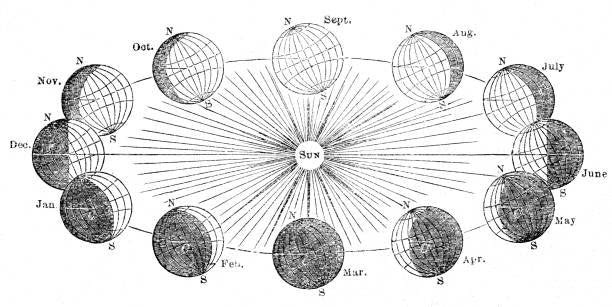
In the northern hemisphere, today Thursday March 20th,2025 is the Vernal Equinox. Even though we won’t be able to see it, at exactly 5:01 a.m. Eastern Daylight Time the sun will be at an exact vertical angle to the equator. Over the next few months the sun will continue angling more and more towards the Tropic of Cancer meaning the days for us in the Northern Hemisphere will continue lengthening until reaching an apex at the Summer Solstice. Today then is also the beginning of the next seasonal node, also called Vernal Equinox 春分.

At this point, in the Chinese calendar we are in the middle of Spring, but in the western calendar we celebrate Vernal Equinox as the beginning of Spring. In Persia this day was traditionally revered as the beginning of the year (called Nowruz), and Rosicrucian mystics count Vernal Equinox as the New Year as well (Happy Rosicrucian year 3378!). Even in ancient Rome, early calendars marked March as the beginning of the year which is why even today September is thusly named because originally it was the seventh month (septem meaning seven). October and November follow being the 8th and 9th months of the Roman year (octo is eight and novem is nine).

Why does the Chinese calendar regard Vernal Equinox as the midpoint of Spring? Because we are now at the balance point of Yin and Yang. If the height of Yang is the longest day (Summer Solstice), and the height of Yin is the longest night (Winter Solstice), then the midpoints and thus points of balance are the Equinoxes.

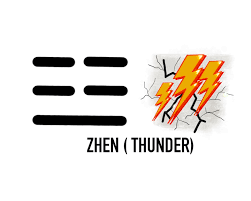
The three 5-day periods in this seasonal node are Swallows Arrive (xuanniao zhi 玄鳥至), Thunder Starts Resounding (lei nai fasheng 雷乃發聲), and Beginning of Lightning (shi dian 始電). In Yijing (I Ching) theory the Thunder Trigram – Zhen Gua 震掛 – is a Wood trigram, linking thunder and lightning, yang activities of the heavens, with Spring. Zhen Gua is composed of one solid yang line on the bottom, with 2 yin (broken) lines above. This is the image of Yang emerging from underneath, continuing to grow up and out. Spring is exactly that time of year – the time when Yang of the natural world is slowly starting to push itself up and out of the Yin of Winter. 

The main thing to focus on during this 15-day period is “Nourishing the Liver” (yang gan 養肝). One of the ways we nourish the Liver is to ensure normal Liver function. For example, this is the time of year to really ensure our patients’ Qi is freely coursing (one of the main functions of Liver is to ensure normal coursing of Qi). The second “to do” during this time is to “both Clear and Supplement.” This means that when the Liver is hot or hyperactive, clear and sedate. When it is vacuous (e.g., has Blood vacuity), then supplement. Since any pattern of disharmony in Liver will impair some of its major functions, when we see Liver patterns during this seasonal node they must be treated. That said, this year, at least here where I am located, the weather is still chilly, especially in the mornings. As such we may have to protect the warm-Yang in the body at the same time we clear Liver or supplement the Yin-Blood. A beautiful example of this is harmonizing formulas such as Xiao Chai Hu Tang, or even Xiao Yao Wan. Both contain herbs that strengthen and supplement (e.g., Ren Shen, Bai Zhu) alongside herbs that course or clear Liver. We can also consider giving our vacuous patients pill-form warming and supplementing formulas together with powders or decoctions that have a more Liver coursing or clearing function.

As mentioned already, the Vernal Equinox is the time of balanced Yin and Yang. It is appropriate at this time to also have balanced mind states. Thus, one of the “avoids” during the Vernal Equinox is extremes of the Seven Affects. Chapter two of the Su Wen says that Spring is the time to not be angry. We should try to relax, and not allow our emotions to run too far in any direction. The second thing to avoid during this seasonal node is overdoing “bedroom activity.” Since sex stirs the Yang to mobilize Jing-essence, to keep an overall balance in health we need to seek a balance in sex. As this time of year is a time of balance, too much sex may deplete the Yin-Jing. That said, no sex at all can lead to stagnation in the circulation of Qi and Blood.

Diet for Vernal Equinox

Diet for the Vernal equinox should mimic the balance that is present in nature at this time. In general, the continued use of mildly acrid foods such as ginger and scallions help ensures normal coursing of Liver qi. This is especially useful for patients with Liver depression patterns. Patients who tend more towards vacuity patterns, especially Liver blood insufficiency, can increase consumption of sour foods such as pickles or vinegar. This year since the weather is cold though, we should continue to eat slightly warming foods. However, it is best to avoid very greasy or cloying warm foods (such as an overconsumption of very fatty meats), or very salty meals. While saltier and slightly greasier are ok in the cold of Winter, right now in Spring we need to be concerned with the normal and smooth movement of Qi and Blood in the body. The basic combination then is warming and acrid, such as the aforementioned ginger.

A simple tea most patients can consume during this time is rose bud tea. This tea is made by steeping Mei Gui Hua 玫瑰花 in hot water. Mei Gui Hua is warm and sweet and is found in the Qi regulating chapter of the Materia Medica. It courses Liver as well as gently quickens the blood. It is especially useful for our female patients who have menstrual irregularities due to Liver stagnation. In the Baijiquan 八極拳 system of Chinese marital arts, Mei Gui Hua tea is used as a general Qi and Blood moving tea for injury. For patients who suffer from more internal cold, Mei Gui Hua can be combined with Gui Zhi (cinnamon twig) or Sheng Jiang (fresh ginger).  

One traditional dish for Vernal Equinox is Stir Fried Pig Kidney with Eucommia (杜仲豬花). Here’s the recipe:

Ingredients:

  • Organic pig kidney ¾ to 1 lb
  • Eucommia bark (Du Zhong 杜仲) 6-9g
  • 1 scallion, 1 piece of ginger (about the size of your thumb or a little larger), 1-2 cloves of garlic
  • Cooking oil, salt, soy sauce

Directions: 

Cook Du Zhong in about 1 cup of water by bringing to a boil and then simmering until only about ½ cup of liquid is left

  1. Cut kidneys into thin slices and then score one side of each slice; peel and slice the ginger, slice the garlic, and slice the scallion
  2. In a pan, add a small amount of cooling oil, and start by cooking the garlic and ginger just until fragrant and / or the garlic is transparent. Add in the kidney slices and cook for several minutes. Then add a small amount of salt and soy sauce.
  3. Add in the Du Zhong liquid, and cook down in the pan with the kidney. Add scallions. Cook until kidneys are thoroughly cooked through.
  4. Optionally can add Gou Qi Zi (i.e., Goji berries) at end as well before liquid has cooked down, cooking until slightly plump.

This recipe supplements the Kidney, boosts essence, and nourishes the Liver blood. It is good for lower back pain, knee pain, declining visual acuity, or other symptoms of Liver and Kidney vacuity. Because it is warming it is especially useful this year!

Acupuncture for Equinox

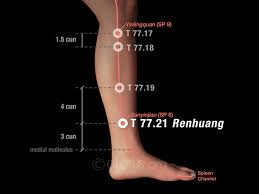
When considering acupuncture recommendations, first we should think about how Wood phase (for Spring) is functioning in our patients. Ideally, we should all be in a state of balance, neither in a state of insufficiency nor of repletion. Relative repletion, especially during the time of transition into warmer weather, frequently manifests as stasis. This is because the Qi of the body, as the time of year is becoming more Yang, wants to move. But since cold weather is still lingering, Qi has trouble moving and stagnation is the result. Another possible reason for stagnation is a failure to increase physical movement this time of year. If this is the case then points that course Qi and Blood throughout the body should be chosen. My recommendation is to consider the Metacarpal Three Needles (掌三針) consisting of Ling Gu 22.05, Da Bai 22.04 and Zhong Kui. On the lower extremities we can add Ren Huang 77.21. If the repletion also manifests with some internal heat, consider bleeding the apex of the ear.

The opposite situation is having a patient with insufficiency of Wood, either in the case of Liver Vacuity (especially patterns of Liver Blood vacuity), or of general vacuity of the Yang. For Liver vacuity we can consider points such as the Upper Three Yellows (上三黃; 88.12, 13, 14). Alternately, we can choose the Lower Three Emperors (下三皇; 77.17, 19, 21), https://www.youtube.com/watch?v=i9uYZ9OXPCs one main Dao Ma group for the Kidney. Why the Kidney Dao Ma group? Because strengthening Water-Kidney automatically strengthens Wood-Liver because of the Five Phase engendering cycle relationship.

Acupuncture for Endometriosis related Pelvic Pain

Acupuncture for Endometriosis related Pelvic Pain

Endometriosis is a complex condition that affects 1 in 7 women, girls and those assigned female at birth and is considered a leading cause of pelvic pain (1).

Managing Endometriosis is not a one-size-fits-all approach and current treatments including Laparoscopic surgery, and pharmaceutical and hormonal treatments do not always provide symptom relief (2). Treating Endometriosis and associated symptoms will differ for each individual and ideal care requires a multi-disciplinary approach with evidence-based treatments and patient-centred care.

Previously in The Dao Does journal, Clarice Berry outlines what Endometriosis is, the symptoms associated, the causes and how Traditional Chinese Medicine treats Endometriosis.

You can read this post here:

How Chinese Medicine & Acupuncture Support Endometriosis ~

Managing Endometriosis related Pelvic Pain

Pelvic Pain is a significant and common symptom associated with Endometriosis. Acupuncture treatment can be considered a complementary treatment to consider as part of a multi-disciplinary approach when it comes to managing endometriosis-related Pelvic Pain.

Acupuncture decreases pelvic pain through physiologic mechanisms which reduces pain in the local pelvic region as well as the body overall.

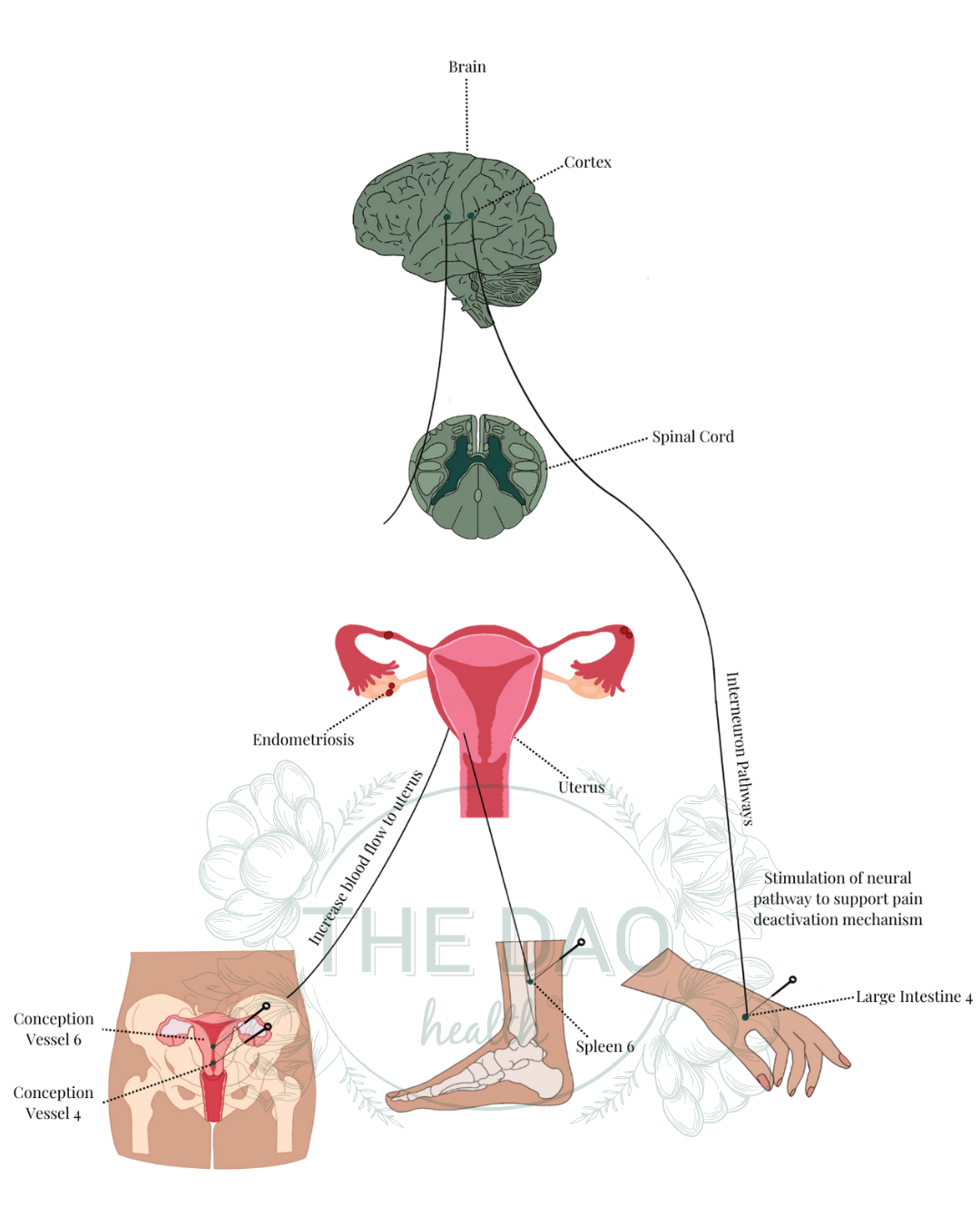
This occurs through the insertion of specific Acupuncture points which stimulate nerve receptors and neural pathways to support the pain deactivation mechanism via the Cerebral Cortex. This, in turn, activates the body’s release of Opioids as well as regulates the autonomic nervous system and central nervous system resulting in pain relief.

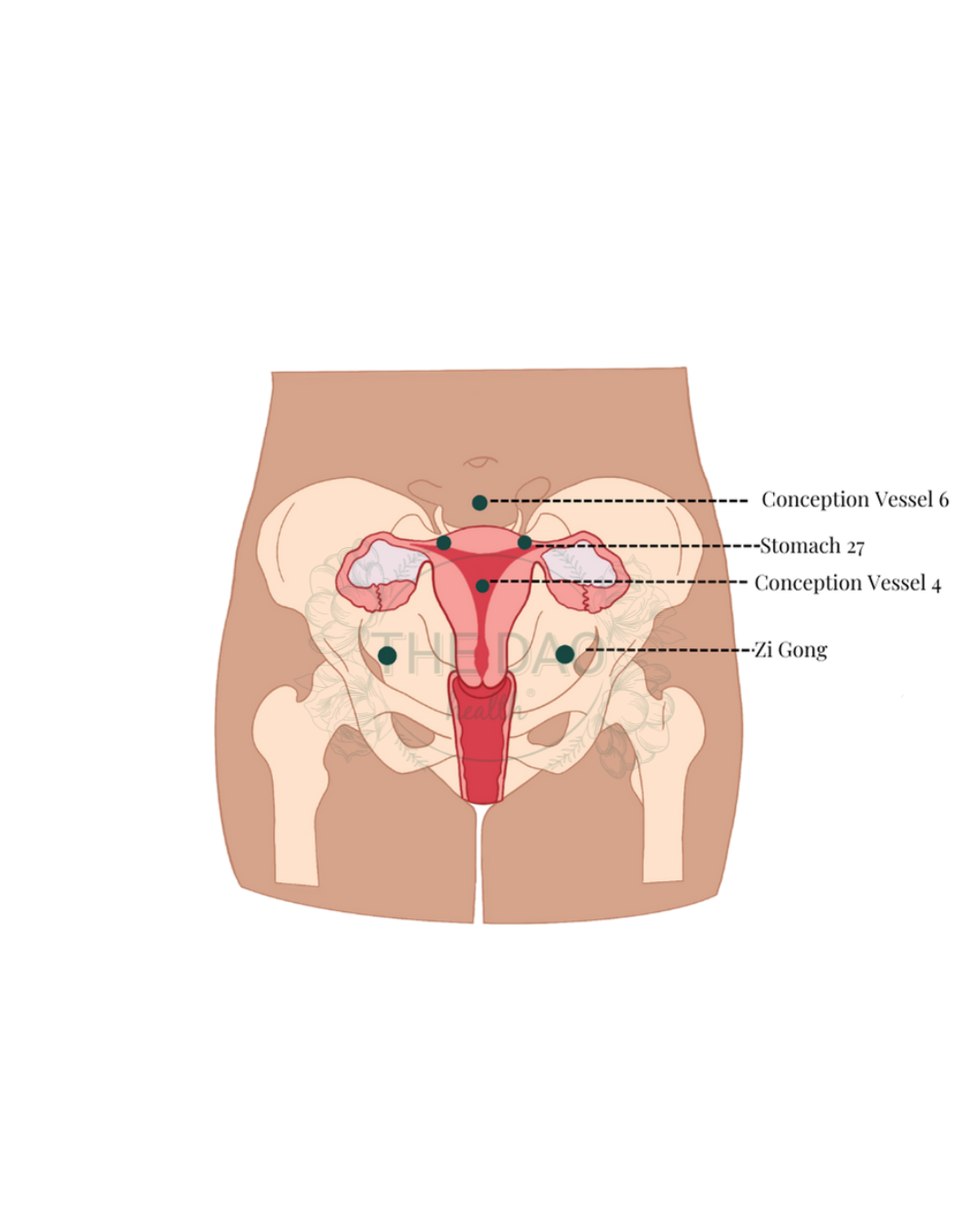
In the above diagram, you can see two acupuncture points used to reduce pain relief distally, Spleen 6* and Large Intestine 4.

*Please note, that Spleen 6 is contraindicated in pregnancy and should not be used in treatment for patients trying to conceive from Ovulation in the Luteal Phase or pregnancy to 36 weeks.

The local points on the Pelvis include Conception Vessel 6, Conception Vessel 4, Zi Gong and St27 and these are a number of examples of Acupuncture points that increase blood flow to the Uterus which supports to reduce symptoms of pelvic pain in addition to other Endometriosis symptoms such as Dysmenorrhea, otherwise known as period pain and cramping.

What does the research tell us?

The research continues to support that Acupuncture is a clinically relevant option to consider for the treatment of Endometriosis and pelvic pain (2).

A 2021 randomised controlled feasibility study by Mike Armour et al. looked at determining the acceptability and feasibility of Acupuncture for the treatment of endometriosis–related chronic pelvic pain.

The intervention group received Acupuncture twice a week for eight weeks with a set needle protocol. The control group received usual care alone which involved no additional support or treatment than the participant was receiving before the trial. The Dao Health and I were involved in this study as one of the clinics that provided treatment.

The results concluded that there was a 48% decrease in pelvic pain from baseline to the end of the trial in the Acupuncture group compared to the usual care-alone group and a 20% decrease in overall body pain (3).

Acupuncture as a complementary treatment to consider for Endometriosis related pain is further supported by Y Xu et al. systematic review and meta-analysis study from 2017 which researched the effects of acupuncture for the treatment of Endometriosis related pain. The study’s outcomes resulted in Acupuncture providing a significant reduction in Endometriosis related pain, primary pain levels and a decrease in CA-125 levels compared to the specific control groups (4).

Most recently in October 2023, a systematic review and meta-analysis by Nora Giese, Ky Kyung Kwon and Mike Armour looked at Acupuncture for Endometriosis and examined the effectiveness of acupuncture on pain and quality of life in people with Endometriosis. The study concluded that Acupuncture treatment for Endometriosis demonstrated clinically relevant improvements in pelvic pain and should be considered as a potential treatment intervention (2).

A Clinical Reality

When it comes to considering Acupuncture treatment to manage Endometriosis and related Pelvic Pain, it is important to have a clear expectation of the amount of Acupuncture that will be required for managing symptoms. From a biomedical perspective, due to Acupuncture having a physiological effect on the body, it should be considered to have a dose. Similar to checking a medication’s dose before use for effective menstrual pain relief, Acupuncture can also be viewed as having a dose. This means that for Acupuncture to have an effect on the body a series of treatments is required to see whether Acupuncture is effective or not for a patient individually.

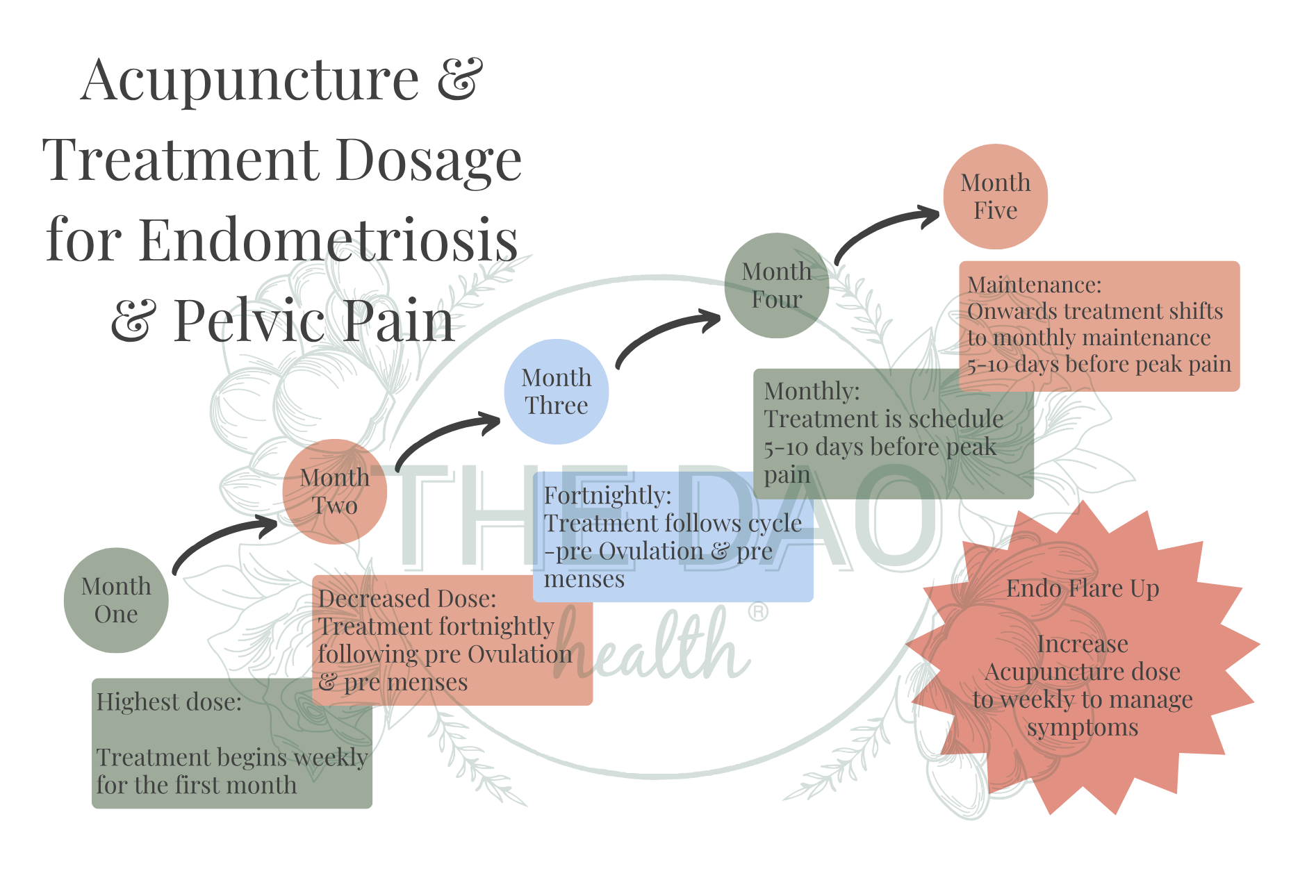
From clinical experience, I do not expect for a patient to have a significant change in symptoms after one Acupuncture treatment and discuss with a new patient that a minimum of 8-12 treatments over three months is recommended to manage Endometriosis.

As you can see in the below table, Acupuncture treatments begin at a high frequency and then reduce to maintenance. Interestingly, Acupuncture treatments are timed with the menstrual cycle or cyclical pain and I recommend treatment 5-10 days before expected peak pain. In a time of an Endo flare-up, treatment increases again.

An integrative model of care

For patients considering an integrative model of care, it is important to build the team around you with medical professionals and health practitioners who listen to you and your symptoms.

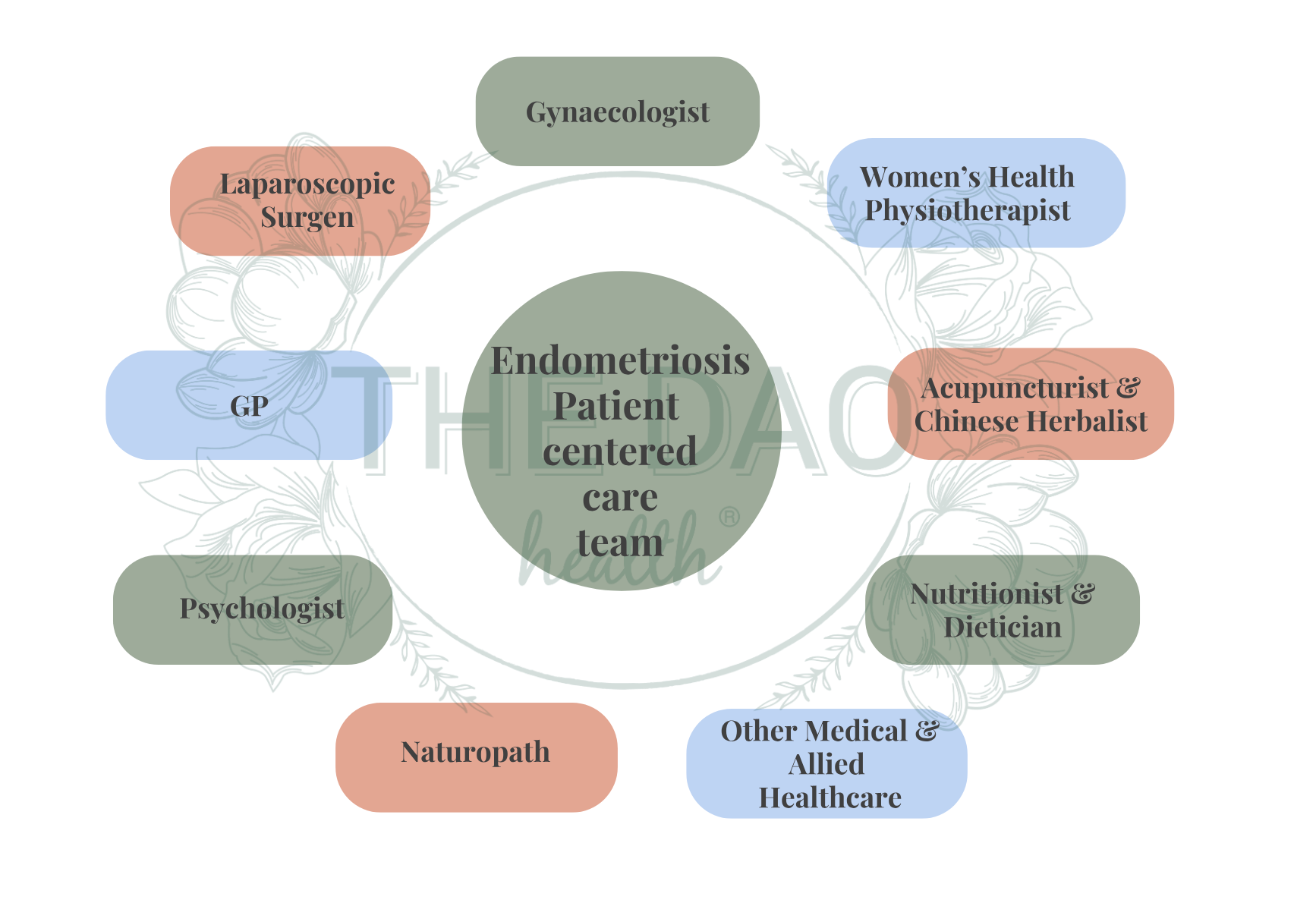
From my clinical experience, I find an integrative model of care is ideal for Chronic Pelvic Pain and Endometriosis. This includes a Pelvic Floor Physiotherapist who can assess your pelvic floor internally and externally. In patients who receive treatment from both allied therapies of pelvic floor physiotherapy and acupuncture, anecdotally I find faster improvements with patients with more positive outcomes.

I would like to also discuss the barriers to an integrative model of care including accessibility, the time dedicated to appointments and the economic burden that comes with a diagnosis of Endometriosis which in 2017 was estimated as $30, 900 per person. It is also important to note that costs increase with pain severity, with costs for people with severe pain being six times higher compared to people with minimal pain (5). Hopefully, in the near future we see an improvement in these barriers through further funding and government support.

I have included what an integrative patient-centred model of care can look like for patients when looking to build their care team around them.

Investigating Pelvic Pain

On a final note, persistent pelvic pain affects 10-20% of women and should always be investigated. Quoted from Dr Amani Harris, advanced Endoscopic ( Laparoscopic and robotic ) gynaecological surgeon and obstetrician summarises this well saying “Not all Pelvic Pain is Endometriosis, but Pelvic Pain should be taken seriously, assessed and treated”.

You can read this interview from Jean Hailes Women’s Health Week 2023 Journal Series here ~ The Progress on Endometriosis 

For further resources, please see the below episodes on the Integrating Chinese Medicine podcast:

~ The ABC of Acupuncture Bioscience CBD Oil with Mike Armour

~ Endometriosis & Adenomyosis, Empowering the Conversation with Dr Amani Harris

~ Overcoming Your Period Pain

~By Elizabeth Cullen (BHlthSc (TCM), MWomHMed)

References

1.Mooney SS, Grover SR. The persistent pelvic pain study: Factors that influence outcomes in women referred to a public hospital with chronic pelvic pain – A study protocol. Aust N Z J Obstet Gynaecol. 2021 Apr;61(2):E6-E11. doi: 10.1111/ajo.13289.

2.Giese N, Kwon KK, Armour M. Acupuncture for endometriosis: A systematic review and meta – analysis, Integrative Medicine Research (2023), https://doi.org/10.1016/j.imr.2023.101003

3.Armour M, Cave AE, Schabrun SM, Steiner GZ, Zhu X, Song J, Abbott J, Smith CA. Manual Acupuncture Plus Usual Care Versus Usual Care Alone in the Treatment of Endometriosis-Related Chronic Pelvic Pain: A Randomized Controlled Feasibility Study. J Altern Complement Med. 2021 Oct;27(10):841-849. doi: 10.1089/acm.2021.0004.

4. Xu Y, Zhao W, Li T, Zhao Y, Bu H, Song S. Effects of acupuncture for the treatment of endometriosis-related pain: A systematic review and meta-analysis. PLoS One. 2017 Oct 27;12(10):e0186616. doi: 10.1371/journal.pone.0186616.

5. Armour M, Lawson K, Wood A, Smith CA and Abbott J (2019) ‘The cost of illness and economic burden of endometriosis and chronic pelvic pain in Australia: A national online survey Doi: 10.1371/journal.pone.0223316.

The Energetics of the Torso

The San Jiao disseminates the Yuan Qi out of the Kidneys, and it is the San Jiao mechanism is that which creates the energetics associated with the front Mu and back Shu points.
Although the San Jiao does not have form we can say that it is represented by the vortex that moves from ST11 (Qi She – The Qi Abode) down to the navel (Ren8 – She Que – the Spirit Watchtower). Life begins with the first inhalation and the severing of the umbilical cord. It is said that at this time the child sucks on and swallows the “mud pill” the substance of Jing, which will now move down to the site of injury (Ren8) and down to reside in the Kidneys. This creates the San Jiao vortex.

Life begins with the breath, represented by Metal, and the activation of the Mu points, the pooling of Jing, is a trajectory that follows the creative cycle of the 5-Phases.
With the first breath and the swallowing of the mud pill, the throat and collar bone are activated, moving through ST11 (Qi She – the Residence of Qi) to the basin (ST12 – Que Pen: Empty Basin), the Qi Door (Qi Hu) to LU2 (Yun Men – Cloud Gate). LU2 is considered as the Mu point of the Lungs for this model (as it has been in ancient times). This is the awakening of the Yang, creating the first communication with the external world. Now the breath is drawn downwards to the navel and lower Dan Tian, going into ST25 (Tian Shu – the Heavenly Axis, also named Bu Yuan – Tonify the Original Source) the Mu point of the Large intestine and a point directly related to Yuan Qi and the Kidneys. Along this path is ST17 (Ru Zhong – breast centre), the nipple: that is where the infant is going towards once the umbilical cord is severed.

Once the first breath and exposure to the external environment has been fulfilled, the journey to our destiny begins. From ST25 the trajectory both ascends and descends. We now move from Metal to Water.

The descending trajectory moves down to the phase of Water, to the Bladder Mu point, Ren3 (Zhong Ji – Central Pole), the lowest Mu point, delineating the lower border of the Mu energetics domain, the origin of the 8-Extra vessels, and the confluent of the leg Yin sinews. Zhong Ji is the line between Yin and Yang in the Tai Ji symbol, it represents polarity and movement. As the lowest of the Mu energetics, this is where we begin to polarise towards Yang, and to create the Back Shu points.

The ascending path moves from ST25 towards G.B.25 (Jing Men – Gateway to the Capital). Here, the capital is a reference to the nipple, where post-natal nourishment comes from. Moving towards the ribs and then the breast, towards Yin and nourishment. This path will continue up to G.B.24 and Liv14 through the breast to Ren17 and then down.

Now we move towards Wood. The child learns polarization and differentiation. From the outskirts of the ribs, the Capital Gateway, we move inwards into the ribs proper, reaching G.B.24 (Ri Yue – Sun and Moon), the Mu of the Gall Bladder. The sun and the moon represent polarity and opposites: we need to learn to reconcile opposites in life, external and internal. (The Da Chang lists G.B.23 as the Mu of the Gall Bladder, putting the trajectory as moving further on the side of the ribs.) Then moving on to Liv14 (Qi Men – the Cycles/Peroidical Gate), the Mu of the Liver. Liv14 is the point where we learn to harmonise, move through, the cycles of opposites. It is part of the trajectory of the Yin Wei, our ability to link the various directions in life in its various stages.

From here we move to the nipple, and then on to Ren17 (Tan Zhong – Centre of Chest), the Mu of the Pericardium, moving on to the phase of Fire. Having learned to view polarity and harmonise, we now become conscious of our selves, of who we are. The Pericardium is that which creates the consciousness/awareness of one’s own self and self-related processes.
Below, the trajectory moves from Ren3 to Ren4 (Guan Yuan – Original/Source Gate) and Ren5 (Shi Men – Stone Gate), the Mu of the San Jiao. The Stone represents that which is hard, making us infertile (as the contraindication warns us), somewhat akin to the protective function of the Pericardium which through over-protectiveness can create rigidity. (When moving towards the Heart it is required that we move through the protective layer of the Pericardium, on the lower end, there is no specific order required within the Fire Mu points.)
And having passed through the Pericardium we are allowed entry to the Heart, at Ren14 (Ju Que – the Grand Watchtower). We are no longer on bone, but deep in soft tissue of the body. The heart represents the realm of love and compassion. This is where polarity disappears, and I am able to look at others in the same way as I look at myself.

Finally we can move into the realm of Earth, down to Ren12 (Zhong Wan – Central Receptacle), the Mu of the Stomach and out to Liv13 (Zhang Men – Camphor Gate), the Mu of the Spleen. These are the influential points of the Fu and Zang: that is once the Mu energetics has been activated, the ribs have been engaged, the Zang Fu are activated.
This trajectory, connecting the Mu points from ST11 and the collar bone, through the phases of Metal, Water, Wood, Fire, and Earth, moving down to Ren3, and out to nourish the ribs, can be used therapeutically also. For example, if there is loss of Jing in the Kidneys (loss of the will power to live, or the atrophy and drying out of a kidney), one can enforce the trajectory by using needle directionality, so as to move Jing into the Kidneys. Starting with ST25, needling it out towards G.B.26, then G.B.26 towards G.B.25, the target, and preventing leakage further down the line by needling G.B.24 down and out towards G.B.25. (G.B.26 has been added here because it is on the trajectory, between ST25 and G.B.25, and as an 8-Extra point it also resonates with the Jing.) In a similar manner, one can disperse a Mu point, in cases where there is an over-accumulation of dirty Jing – as in fibroids, by using the points that follow that Mu point along the trajectory to help drain it. One can use palpation as a method of diagnosis, and determine the appropriate flow to be reinforced by massaging the points along the trajectory to determine which relieves the particular Mu point pressure pain.

From the lowest point of the Mu-energetics, Ren3, begins the movement towards the back to create the back Shu points. Although the back Shu points are created through the combustion of the Jing in the Kidneys and the Ming Men Fire, Ren3 still plays a part here too, as the cusp between Yin and Yang, the movement from Mu to Shu. We can in fact trace this physically within our own bodies. If you sit in a chair and slowly push into the legs, and attempt to stand up without tilting the body forward, maintaining the back straight, you can feel the movement being initiated in the lower abdomen, around Ren3. Then the gluteal region is being activated and then the movement goes up the back, all the way to the occiput. 

We can say that this movement is the activation of Yang, of movement, of Wei Qi up the back. As Yang Wei moves up the back, the obstacles it will encounter are the bone structures: the hips, the shoulders, and the occiput. Unsurprisingly all three areas represent immune (or Wei Qi) related areas. The area under the scapular spine relates strongly to, and treats, lung infections, and S.I.12, the point which “grasps the wind” is above that. Pain around the posterior iliac crest is commonly related to weak immunity, and can be treated by immune points. The area under the occiput is the traditional wind area, represented by G.B.20 (the wind pool) and other windows-of-the-sky (heavenly influences) points.

The back Shu points represent movement and transportation. Inherent in the movement of life is the conflict between what is external (the world) and the self. The Back Shu points reflect that. Conflict is represented by the control cycle of the 5-Phases.

At the bottom, we start with the self, represented by Water, U.B.23, the back-Shu of the Kidneys. We can say this is created directly from the moving Qi between the Kidneys, or that it comes from the movement of Ren3 (or both).

At the top, the influences from the world are represented by Metal, at U.B.13, the back-Shu point of the Lungs. We can say that these influences (Qi) have come in through the Wind Pool (G.B.20) down the Great Shuttle (U.B.11) and the Wind Gate (U.B.12).

The “mediating line” between the world and the self is the diaphragm, represented by U.B.17 (Ge Shu, the diaphragm Shu). The diaphragm is that which facilitates taking the world in to our selves, ending in the kidney area (lumbar region), as well as letting it out of the self.
From U.B.13 (Metal) we move down towards the diaphragm, and move to its controlling (conflict) phase, the phase of Fire, through the Pericardium and Heart Shu. Below we see the same idea of moving through the conflict upwards toward the diaphragm, moving from Water (U.B.23, back-Shu of the Kidneys), to that which controls Water (Earth), and then to that which controls Earth (Wood). And thus we move from U.B.23 to U.B.21 and U.B.20 the back Shu points of Stomach and Spleen, representing the Earth phase, and then to U.B.19 and U.B.18, the back-Shu points of Gall Bladder and Liver, representing the Wood phase.

The Large Intestine and Bladder, as excretory organs, are placed at the bottom. The Small Intestine represents our last chance to separate the pure from the turbid, to cleanse ourselves of karma, and thus it relates to the Gate of Po, and is therefore placed below, near the anus. The San Jiao Shu (U.B.22) can be seen as representing Fire and thus the conflict between Water and Fire as the movement goes up from U.B.23 to U.B.21. Alternatively, it can be viewed as part of the self, as in this case the San Jiao is what disseminates the Yuan Qi out of the Kidneys.

Su Wen 58 adds 12 Shu points on the chest, Kid22 through Kid27 bilaterally, wih only U.B.17 mentioned as a Shu point on the back. Kid27 can be seen as the Master point of all Shu points: this is derived from its name Shu Fu, Transportation Exchange Place/Mansion. When we view the notion of transportation (Shu) points as representing conflict, imbalance between interior and exterior, the self and the environment, the terrain of this struggle is the chest and the diaphragm, and hence Su Wen 58 mentions the front Shu points and the Shu point for the diaphragm. If one were to utilise these points then Kid22 (Bu Lang) would represent the Kidneys or Water, Kid23 (Shen Feng) would represent the Earth organs, Kid24 (Ling Xu) the Wood, Kid25 (Shen Cang) the Fire, and Kid26 (Yu Zhong) would represent the Lung and Metal phase.

The mutual reflection of the back and front can be seen in other aspects also, with Ren15 (Jiu Wei – Dove Tail) and the tailbone being the axis. The xyphoid process can be seen as a mirror image of the tailbone, and hence the Luo of the Ren is at Ren15 while the Luo of the Du is at DU1. DU1, Chang Qiang – the Long Endurance/Forcefulness, begins the image of the spine as a ladder to be climbed in the process of our lives, until we reach the top, the head/brain, the place that accumulates all our experiences and memories. It is said that we are given 7 Pos (earth bound souls) in our life time so as to experience the earthly life (these experiences are then “reported back” and join the Hun, the collective/ancestral consciousness). Each Po is expressed and tries to resolve its lessons during one cycle of 7/8 years. Then the resolution of that Po’s lesson is hopefully achieved and the next Po’s issues (as dictated by its “karma”) are being put forward in our lives.

The Po are said to reflect on the spine, starting at DU2, moving on to DU3 and so on until all 7 Pos are experienced. By DU9 (Zhi Yang) we are (hopefully) free of the attachments to the physical issues in life, and can now become more Yang, and express the lighter, spiritual, potential of our lives, and so the upper thoracic spine represents our spiritual growth free of attachment with names such as Ling Tai (DU10 – Spirit Tower) and Shen Dao (DU11 – Spirit Path), which is presumably the pillar of our lives (DU12 – Shen Zhu – Person’s Support). On the front a similar process occurs with the Po moving along one point with each 7/8 year cycle, this time down from Ren15, reaching Ren8 (Shen Que – Spirit Watchtower) once the seventh and last Po has found its resolution.

In looking at the name point progression up the Ren channel we can learn much about the process of life. The Ren (Human) represents the human ability to take on the burden/task of life. In looking at the channel we see that the process of life is about alchemical transformation of the Jing into Shen by the use of the Qi (relationships, interactions), of spiritually accumulating experiences, of taking in the world, individuating our perception of the world, and of projecting our individuality back to the world. The channel also describes some of the obstacles inherent in human life and those which prevent us from smoothly going up this route. The Ren represents the passage of Jing (the rice that represents life essences – cinnabar) through the transformation of Qi (relationships).

Beginning with Ren1(Hui Yin), the meeting of Yin essences, Jing, and physicality, we move on to the Curved/Secret Bone (Ren2 – Ju Gu) where we can gather the Yin (in that curve) before ascending it up further. Zhong Ji (Ren3 – Central Pole or North Star) is where the ability to reproduce life comes from and to release Yang. This is the centre of the human cosmology, where all channels start (the Ren, Du, and Chong – the mother of all meridians), and where transformation (Fu – bladder) takes place.
We now pass through Guan Yuan (Ren4 – Source/Origin Gate): passing through here allows for the possibility of the Yuan Qi, the pre-given, to be expressed in the post-heavenly life. Now we can start to experience the fire of life. Shi Men (Ren5 – Stone Gate) represents condensation of essences (as if into a stone) but also the possibility of passage and transformation as it is the Mu point of the San Jiao. At Qi Hai (Ren6 – Ocean of Qi) we arrive at vastness (the ocean), manifestation of Yang, and the source of the Huang: the envelope that protects the Qi and deep circulation. The Jing is only useful through the circulation and activation of the Qi, otherwise it is inert. Before we move on to the next level, where Qi, rather than Jing, is predominating, we recharge our ability to collect the Yin: this is Yin Jiao (Ren7 – Yin Meeting).

We now welcome the spirits, our life’s animation, at Shen Que (Ren8 – Spirit Watchtower). This is where, by having good and nourishing essences we can attract the spirits. But there is also a barrier here, as this is also a point on the Dai channel. We now have separation of Water and Fire (water as represented by the Jing, and Fire by the animation of our lives), and we need to be able to separate the pure and the turbid, which is represented by Ren9, the Dividing Water (Shui Fen). We move on to the three receptacles, the 3 cavities that represent our ability to receive what comes down from Heaven (and made available through the transformative power of the earth). These are Ren10 (Xi Wan – the Lower Receptacle), Ren12 (Zhong Wan – the Middle Receptacle), and Ren13 (Shang Wan – the Middle Receptacle). Ren11 (Jian Li – Standing Miles) represents our ability to create the basic units of life (Li is a village, or a field on the earth). These all represent the assimilation of the world and how we bring the world to our heart, at Ren14. Our ability to be in harmony with what we take in before we pass it on to the heart as an experience (Shen – something that is now part of our spirit) is guarded by the last barrier before coming to a bone: Ren14 – the Mu point of the Heart. Ren 14 (Ju Que – the Powerful Watchtower) also represents a sword protecting the heart, the sword of understanding we hope. However, as in the case with the other Que – Ren8, this is also a representation of a major potential obstacle, the diaphragm.
Next comes Jiu Wei (Ren15 – Dove Tail) representing the protection offered by a bird’s wings. It is also the Luo of the Ren, and as a Luo point it also allows passage: we can allow things to move out in case there is too much protection being exercised. Sun SI Miao calls this point Shen Fu (Spirit Exchange Place). Finally we may arrive at the Heart, the emperor, a destination that might seem to be our ultimate goal. We reach the Palace at Ren16 (Zhong Ting – Central Palace). But here, again, we encounter more layers, more protection: this is merely the central yard where people gather for an audience with the emperor, not quite the emperor’s residence. Here we are ready to encounter the influences of the Heart. The character for Ren17 (Tan Zhong – Central Altar, usually translated as the centre of the chest) suggest that one may enter through a double fence if they are illuminated and inspected by the sun: a representation of the Heart Protector, the Pericardium, whose Mu point this is.

All the essences have come up to serve the spirits, and we are now at the point of virtue. This is Ren18 (Yu Tang – Jade Reception Hall). Jade representing virtue. The Heart has the perfect ability to receive all of life (in this journey from the lower and middle Jiaos) and to express all virtues. And now we finally arrive at the residence of the Great One (the Tai Yi, the supreme unity): the Purple Palace, Zi Gong, or Ren19.
But the Ren channel does not stop here. The purpose of life is not to merely turn our essences/physicality into spiritual experiences of the Heart. We need to do something with those experiences, to express and distribute our life’s experiences and understanding. If we fail to do so, we will go nowhere and be stuck in an internal process that fails to interact with the world, going nowhere. And so, having reached the Purple Palace and having encountered the Tai Yi, we arrive at Ren20 (Hua Gai – Flower Cover/Canopy), representing both the flower – the blossoming of our heart, the achievement of having arrived here – and the suggested next step, moving out into the world, giving to the world the fruit of our true heart: a canopy or umbrella has an outward and spreading motion. More spreading and outward motion is suggested by Ren21 (Xuan Ji). Xuan Ji is an astronomical instrument that allows us to look out into the heavens , looking around the sphere of the heavens from our point of observation. Because all sextants fix themselves by use of the north star, Ren21 relates to Ren3 (Zhong Ji – the north star), indicating that good expression, circulation, and distribution of our life’s experience is related to a good centre and good essences.

On the way to nourish the head, the face, and the orifices, that which will aloow for expression as well as further reception, we encounter Ren22 (Tian Tu – the Celestial Chimney). The sternum represents the assimilation of our life experiences by the Heart, and its expression. Ren22 is the phonetic expression of what has already taken place in the sternum: the smoke bursts out of the chimney. As a chimney it can be a major clearing point for the whole chest. Ren23 (Lian Quan -–Spring of Integrity, often translated as Angular Spring) relates not only to the integrity of our speech through the root of the tongue, but also to how we stand up, how we view the world by standing on our feet (Kid1 – Yong Quan: the character Quan relates Ren23 to Kid1). The final point we encounter is Ren24 (Cheng Jiang – Receiving the Gravy), where we receive not only the essences of foods, but also the results of our life journey, and conserving what is already inside, that which has been alchemically transformed along this journey up the Ren. And now the Ren moves up to its final destination of expression: the eyes (ST1 – Cheng Qi – Receiving Tears).
The Ren describes the rite of humanity in transforming Jing to Shen, assimilating the world (represented by the receiving of food in the Middle Jiao), expressing the Shen (experiences) by opening our heart and allowing the experience to become part of ourselves, then to move on and to become what expresses us as individuals to the world, and to affect further interaction and perception of the world (mouth and eyes).
The Ren channel also describes some obstacles in this journey. The two obstacles indicated are at Ren8 and Ren14. Both represent a passage from one Burning Space to another, and both carry the character Que, watch tower or legislative post, in them. The character Que, indicates a high tower from where one would watch for the movements of the enemy and post notices regarding such movements. Anatomically they represent the diaphragm and the Dai. (The primitive Dai channel is a horizontal line going across G.B.26, SP15, ST25, Kid16, and Ren8.) Also the Heart and genitals (the Dai represents our genitals), two of our life aspects that we need to watch over to ensure that they are open in a manner that is real and represents our true selves

Through the connection to the chest and diaphragm, Ren15 can be said to represent the diaphragm and heart protector. Through the Dai and genitals, Ren8 can be said to represent the Liver. Thus these two watchtowers are a representation of Jue Yin: our ability to differentiate, to decide what we wish to engage our heart with. These two points (and their associations) represent the obstacles of physical attachment (Dai) and emotional attachments (Heart), and the ability to let go of those when we keep good guard of them. When we watch over the muck of our physical and emotional lives, that is when we can bloom as a lotus.

Another way to look at the connection between the diaphragm and the Dai/genitals is through the Dai and Bao vessels. The Dai is said to circulate horizontally at the level of the navel (and then also below reaching to the genitals). The Bao Mai is an extension of the Dai Mai, and circulates vertically between Ren15 and DU1 (the Luo of the Ren and Du). These are the only looping channels (unless we take the Ren and Du to constitute one channel comprising the microcosmic orbit), with Bao Mai representing the ability of Kidney/Water to communicate with Heart/Fire (with similar connotations as those described for the two Que points). The physical symptoms associated with the Bao Mai are Running Piglet Qi, a sensation of energy surging upwards in the torso.

In Search of A Philosophical Medicine

This article is also available in its published form CJOM, Vol 11, No. 2 Spring 2000 (pdf)

All medicine is philosophical in nature.  Even modern medicine is based on our modern-day understanding of life as a biochemical, possibly mechanical, process. Chinese medicine also is based upon certain philosophical understanding cloaked in cultural terms appropriate to its time and geography. If we get caught in the language used we might loose sight of the essence of the medicine: its view of the human process. When we look deeper, past the cultural differences, we can find the core statements and realise their relevance to our lives also.

The I Ching (Classic on Change) represents the bases of Chinese understanding of life. Change is what life is about – everything changes, nothing remains static. The character I (change 易) represents the sun and movement, like the movement of a flag in the wind. It is one stroke different from the character yang. Life is about change: if we did not change all the time, no biological, or any other, process would ever take place, we would never transform from sperm and ovum to embryo, to baby to child, to adult, etc. Inherent in this concept is the notion that life is about being yang, interacting, moving, changing.

The process of life is the process of change, of movement. Thus we must respect change, even when if sometimes we perceive the change to be adverse to how we currently perceive our happiness and health. To study life, and medicine, is to study change, its course, and the response to change. Because change is inevitable and natural, we must conclude that pathology must be the result of our response to change.

The character feng (wind 風) also connotes the sun, motion and extension, that is it represents the currents produced by the sun (atmosphere). One stroke off is pan feng (half wind) which is said torepresent a worm, something that is being pushed, and a hook that entices. This is to say that Wind is what entices us, pushes us, into change. We can view change and wind as synonymous. This is why we say that wind is the spearhead of all disease (in disease we have changed from “health” to “disease”).

Since change is inevitable and natural, we must look at our response to change as the cause of disease. Hence the major schools based on response: Cold (Shan Han), Heat (Wen Bing), and Dampness.

The character Han (cold 寒) represents a person who is separated from his/her field (work) and is crying. This is an inability to produce, an inability to move forward. Cold is the response that locks us in, refusing to change, perhaps even a denial of change. Cold physically represents contraction and lack of movement. Philosophically it represents the exact same qualities: a refusal to engage with the world. When looked upon as a response to an external pathogen we might call this the tai yang response – we fend off against change, becoming stiff and rigid (getting body aches and stiffness).

Heat is expansive, full of motion. When we are overeager to change, when we move too quickly towards the world, that is when we have Heat. Again, this can be a physical response or an attitude towards life, or both. We can call this the yang ming response, internalising the change/movement, creating heat (movement) inside our body.

Dampness is the viscous quality that makes it hard to move in either direction. It comes from hesitation, being uncertain as to whether to move with the change, towards it, or against it. We might alternate between being “cold” and being “hot” towards the situation (change) at hand. This is the shao yang response: “maybe this, maybe that.”

We can further say that Dryness is the result of Heat drying up our resources and exhausting our resources. Summer Heat can be said to be a combination of Heat and Dampness, one in response to the other, that is the Dampness is trying to slow down the Heat or the Heat is trying to get rid of the Dampness.

When viewed in this manner we understand that wind is not really the cause of disease, but merely the enticing factor. Our reaction to wind, that is, some rigidity within us, is what causes the disease. I refuse to change (Cold) because of some pre-existing attitude within me. Or I try to move too fast because of some resentment toward my current

state and this is enticing me towards movement away from the present. Or I might be holding on to both desire for and reluctance to change (Dampness). Any of these responses represent some inability to be in the present as it is, some rigidity, an attachment to the past, or an over-zealous determination to be in the future. The climatic factors are no longer external issues, but reflect our own responses to the world, responses that we can take responsibility for.

Movement and interaction are inherent in the human condition. This statement is reinforced by the order of the regular meridians. The human condition requires survival, that is, air and food, represented by the Lungs and Spleen (as well as Large Intestine and Stomach). But our physical survival is not enough, we then need to move towards life and interact with it in order to gain what we perceive as sovereignty over the world. This is the Heart and Kidney (as well as Small Intestine and Bladder) representing movement (circulation) and what enables one to move (the skeleton/bones). This is the self as it moves out to “conquer”/understand the world around it. But one always limits which experiences, or which understanding, one wishes to engage in. One becomes more aware of what one wants to engage in and what one wishes to ignore: I may choose to become a mathematician or a doctor, or an actor, or whatever, and concentrate my interactions with the world to those suitable for my choices. This is the Pericardium, the Heart protector, and the Liver (as well as San Jiao and Gall Bladder): the organs responsible for protecting (limiting) us and detoxifying (or creating smooth flow in Chinese terms – smooth flow means harmony with the world). Thus we see that our movement may have some inherent rationale and inner structure.

Having understood that humanity dictates that we seek to interact, “conquer”, and understand (limit) the world around us, and having looked at change as representing the “world” side of the interaction, we now need to look at the terrain of the human being in order to understand the “human” side of the process.

We say that the human is the level representing the interaction of Heaven and Earth. Thus we look at three levels of qi (influences): wei, ying, and yuan (or jing). The yuan qi is that which represents our original pattern, our connection to our ancestors (from where we came), and our destiny. Wei qi represents our spontaneous reaction to the worl which might be defensive but could just as easily be offensive. Ying qi is that which nourishes the self, which can be food, thoughts, or emotions. We look at these as three levels of depth as well as qualities.

Wei qi, being spontaneous, is, theoretically, accepting of change, since it is spontaneous, it has no rigidity, not preconceived patterns: on this level we may accept change or reject it all together without being bothered. When change occurs on the yuan level, this means structural changes of the organs (or bones) and/or our destiny. Changes on the yuan level is the unfolding of our potential destiny in the reality of our life. It is the ying qi that represents the most resistance to change. Ying qi represents our blood, our thoughts, our patterns we have built in order to nourish ourselves. These are often influenced by our learned experiences, our social consciousness. Wei qi represents a desire to be one with the world as it flows currently. Yuan qi represents my desire/ability to be one with the world through my ancestral connection, through the common genetic code, it is my connection to the source of the vast ocean of life. Ying qi is the qi that has the tendency to separate me from the world. In my desire to discover and understand the world, and hence nourish myself, I might become too  consumed with myself as a separate entity from everything else that exists, having become overeager to nourish myself. Ying qi is the foundation of the ego, thus it represents my rigidity, learned behavioral patterns, protecting the perceived self, separating the self from the world. This is where pathology easily develops, through the separation of self and “other.”

If I develop the virtue (de 德) to be in line with the way (dao 道) of all things/nature, then I am able to spontaneously be in contact with the world and with my pattern/destiny without too much interference from the intellect, learned patterns, conceptualizations, etc. We want to be able to nourish ourselves, but not too much, not to the point where feel separated from the flow of the world around us, needing to protect ourselves against the its currents. This is perhaps why we concentrate so much on the treatment of the regular meridians and why we have developed that system to such a greater level: this is the meridian system that deals with blood and wei, that is the system that represents how we nourish ourselves as we interact with and move through the world.

What we have stated up to this point is that the process/purpose of human life is to interact, learn, and understand the world, that change is inevitable and that our resistance to change is what creates disease (blockage in TCM terms), and that the experiences of our interactions with the world go through three levels within the human domain: wei, ying, and yuan. Now we can look more closely at the process of disease. Before we do that we must remind ourselves that in distinguishing stages of pathology we do not mean to isolate one level or phenomenon as independent of others, nor can we say that disease progresses from stage one to stage two in an absolute manner. Any stage or level will inherently contain and reflect the other stages and levels.

As we look at the process of disease we might look at how an unresolved issue disrupts the flow of life. We might say that at first it is on the wei qi level. At first we might not even understand that we are encountering an issue in our lives. We might accept it or we might fight it without much awareness of our response (just like pulling our hands out of the path of fire before having figured out the fire was hot). Later our response might be one of Cold (slowing the change), Hot (moving towards it faster than invited), or Damp (moving both toward and halting at the same time).

If we have not accepted the encountered change we shall start developing greater awareness of its existence. Slowly, we might become more and more irritated by it. Now that it is in our consciousness, it is in the ying level. The response of cold, heat, or dampness become pronounced. We start to “invest blood” in the struggle, the way we digest the world (Spleen) is being affected, our emotional disposition might be affected. Now, it is no longer quite so easy to ignore/expel the “pathogen” (pathogen here means any issue, emotional or physical, that feels foreign to our lives). In this stage there will typically be pain, mental or physical, and the beginning of disruption of function. As the irritation increases, we may opt to “harmonise” the problem, that is, we learn to live with it. The problem is not gone, but it is manageable, it no longer has a pronounced effect on our lives, perhaps it is dormant, perhaps we simply learn to live with the problem, perhaps we suppress its symptoms.

At some stage, we are unable to maintain this “harmony,” or we have become so accustomed and we suppress the problem so strongly that it starts becoming part of who we are. This is the yuan level. Physically this may show as damage to actual structure or organs, while mentally it may show as repression and a change in outlook that is no longer conscious but has become part of who we are (as in “my pain and I are one” or “I am my problem”), or a feeling of total separation from the problem (as if it is a demon that has taken hold of our destiny). Now our destiny is being rewritten.

Another way to describe this process of penetration is through the concepts of latent heat and latent cold. Once the pathogen has entered the ying level, our reaction is no longer spontaneous. Now the enticement for change (wind, or wei qi) is in the blood, and might disrupt what we perceive as our normal functioning. The body mobilises the blood in order to suppress the pathogen. This can be done through defensive emotions, changes in behaviour, or relatively small changes in function and structure, e.g. the building of extra capillaries, or hardening and closure of blood vessels, reduced function so the body is no longer at an optimal level, etc. This is called “latent heat” because we have taken that which is yang (change, movement which are “hot” by their nature) and suppressed it, perhaps encapsulated it with blood. This is the stage that we might observe the Luo vessels on the surface, as those represent the mobilisation of the blood. We may see phlegm nodules, etc.

At some point we will not have enough blood to handle the issue and suppress it. At this stage we start to mobilise the jing in order to keep the suppression. At this stage we might call this “latent cold” as it is the energy of the kidneys (cold), our core, that is being utilised. Here greater substantiation takes place, the encapsulated pathogen begins to become more consolidated, fibroids and tumors are being formed, the loss of function is quite great, and grosser structural changes occur. Eventually, the jing is unable to contain the pathogen, and metastasis begins: the pathogen (heat, movement) is no longer held and starts to spread.

This, of course, is a natural process: we all have issues that we have not dealt with satisfactorily (physical or mental) and which we have suppressed to varying degrees. Thus we all have cancer: encapsulations, mutated DNA (changes in the jing), the potential for uncontrolled growth, and spreading of heat (movement). It might be said that it is all a question of degree and how “reasonable” our response is compared to our functionality.

We can see this process in accordance with the three schools of thought: Cold, Hot, or Damp/Phlegm. This is the process of degeneration, of death and rotting. We can view it as a process of becoming colder and colder, that is less able to function, being less yang. We can view it as a process of Heat, the, possibly uncontrolled, movement towards death, and we can view this is a process of phlegm accumulation, as the body builds up greater and greater accumulations that disrupts clarity and function. Rather than assume a particular dogma, it might be most useful to assume all three are correct, can coexist, and depending on the person, one will be more dominant.

We can also correlate this process of moving from wei to ying to yuan/jing to anatomical blockages. Anatomically we might say that the neck, diaphragm and pelvis represent major thoroughfares in the body, and hence obstacles. At the wei level, one might exhibit wind (cold, or heat) symptoms with blockages in the upper body, the head and neck area. As the pathogen moves deeper, to the ying level, one might get diaphragmatic constriction, while later, as blockages become more substantial, one will develop pelvic obstructions. It is important to note that these three levels cannot be relied upon for palpatory diagnosis since most people will have at least some issues on all three levels, and thus may exhibit hardness/blockages on all levels. However, it does give one the option of freeing these blockages anatomically as an approach to bringing resolution.

This description of the process of disease as the process of creating accumulations emphasises the importance of the fu organs. The fu organs are often given relatively little emphasis in modern acupuncture. However, if we see disease as the over-accumulation of un-dealt-with experiences (toxins) then keeping the fu (bowels) open so that they can fill and empty as prescribed is of utmost importance. (We see this attitude exercised in Western practitioners who believe in the critical role of leaky gut syndrome in chronic degenerative and autoimmune disorders.)

The meridian system is the conduit system of qi. Qi means influences, that is not just righteous qi, but also pathological qi. We can see how the meridian system is involved: Wei qi flows in the sinew meridians, and it is the qi of the lungs. Thus we say that the tendino-muscular meridians (jing jin) are the main meridian system involved on the wei level, and that the liver (sinews are in the domain of liver) and lung are especially related to wei qi response. The luo meridians (luo mai) carry blood, thus they are the meridians responsible for the process at the ying level. (One can argue that the primary meridian system belongs here also.) The spleen (producing blood ying), heart, and pericardium relate to this level. Finally the 8-extra meridians (qi jing ba mai) are the conduits of yuan qi, and the kidneys and San Jiao are implicated here.

Since the regular meridians are conduits of both wei and blood (ying), we can see them as the system that mediates between the wei and the ying levels. It is also possible to see the primary meridians as representing the ying level, and the luo system as representing the bridge between the ying and yuan levels (this is because the luo are said to fill when the regular meridians can no longer hold the pathogen). It is a matter of personal judgement, and depending on the individual presentation.

The divergent meridians (jing bie) represent an attempt to divert the pathogen away from the organs, resulting in the pathogen being pushed into the joints (where these meridians originate). These meridians are somewhat equivalent to the lymph system both in location and function (diverting pathogens). It is the movement of a pathogen from the wei level directly into the yuan level (bones) and it is done so one might not have to consciously deal with the problem (the ying level). Thus we say that the divergent meridians communicate wei and yuan qi, with the exclusion of ying qi.

This view of the channel systems in correspondence with the type of qi, depth of penetration, and stage of disorder/disease can help us when we select treatment points. We might first determine what stage predominates in the particular person. This dictates the channel system we might want to work on as the channel system that corresponds to that level. We also need to assess as to whether we want to encourage the body’s current tendency, or to introduce a new direction. In other words, do we feel the client is ready to handle the issue, or is it perhaps best to help suppress it at this  oint until the client is indeed more able to handle it (this might be especially considered in very weak patients). And what will be needed if the client does indeed confront the issue. The level and strategy/direction chosen can help us in selecting points that resonate with the channel system involved as well as points which might hint to the client’s body-energetic the direction chosen.

For example, if we determine that the divergent meridian system is involved, in, say, the bladder/kidney confluence, and we wish to encourage the pathogen outwards, we might choose to use B 40 and B 10 (the confluent points of this divergent system) with B 67 which is a Jing-Well point activating the sinews, hence indicating the direction towards the wei level, or SI 12 which is the meeting of the three yang zones and which by name (bing feng – catch the wind) implies expelling the wind/change/pathogen factor. (Such combinations are naturally a matter of personal choice for each  ractitioner.)

It is important to remember that the various meridian systems share points. Thus one might say that B 40 is the Earth point of the bladder regular meridian, but it is the lower confluent point of the U.B. Kidney Divergent system. One needs to be quite clear in ones intention as to what one is aiming at when choosing a point, so that you truly do tap into the level you desire to influence. (This also means that rather than picking points by prescription, one might accomplish more by picking points according to their relationship with the problem level and nature.) Nothing can exceed mental intention, however, not all of us have such great mental clarity that we can trust to be transmitted through our needles. Here technique can help.

When intending at the luo meridians for example, one can use bleeding (with a 7-star needle for example) as a technique that supports one’s intention (one need not always get actual blood, but the activation of the blood may well be enough, and one can stop when the area becomes red). The sinew meridians are distinguished by the jing (well) points, which can be anywhere in the vicinity of the nail, not just the corner, obviously needled superficially, the meeting points of the sinews (SI 18, GB13, Ren3, and GB 22), as well as “local” knotted trigger points in the muscles which would be needled superficially like a trigger point. Cupping is another technique that resonates with the sinew meridians. The divergents are needled in the form that creates a circle, going through the lower and upper confluent points first (creating the circle – e.g. left B 40, then left B 10, right B 10, then right B 40), with each needle pointing to the next point to be needled, and needling at the superficial, then deep, then superficial levels at each point.

A common mistake is to make the mechanical correlation between the yuan level and the 8-Extra channels as the treatment protocol of choice. Naturally every issue has some 8-Extra component within it, because there is always some “ultimate self” involved in all action, on all levels. However, not all issues at the yuan level (and certainly not on the other levels), call for treatments of the 8-Extras. Many issues that have become “latent cold” and are threatening to our existence, be they tumors, fibroids, structural and functional deterioration, etc., are not necessarily a matter of the 8-Extra channels. If they are not a “pre-given”, nor have been created at a very early age, then they are not likely to in the 8-Extra domain. Many diseases are in the yuan level and have been created through our behavioural choices over the years, and this would connote the regular meridians (behaviour). In cases of autoimmune disorders, it is wei qi attacking the yuan level, connoting the divergent meridians. Instead of opting for 8-Extra treatments one might consider mu points, the yuan (source) points, as well as the (back) shu points in such cases.

The purpose of human life is to convert the yuan/jing into shen through the alchemical process of the qi. (This statement is substantiated through the progression of point names on the ren, that is the humanity, channel.) Thus we use our jing, and through our interactions with the world convert it to experiences that are stored in the brain/marrow. When the jing is exhausted, life ends, and the hun rejoins the ancestral realm with our life experiences. Hence our ability to influence the yuan/jing through the shen. We have all seen people who overcome cancer and other “terminal” diseases through the power of the mind, demonstrating this principle. Therefore in selecting to work in the domain of yuan qi, we must not ignore the power of the mind/spirit: our target to a large extent is the person’s animation (shen), to allow the shen an exploration that may have been obscured previously.

The treatment methods (of herbal medicine) can also be understood in accordance with this process. When encountering a challenge, or a call for change (wind), the body-energetics, having failed to accept it as useful, will attempt to expel it altogether. This is basically the equivalent of the vomiting method – total rejection upon first encounter. Next we can activate the wei qi. This means that the pathogen has penetrated to some extent, but it can still be expelled, except that it will require effort. These are the sweating and purging methods. Once we have past this stage and the pathogen persists, we might be able to use the “opposition method”, assuming the person is able to confront the issue (physical or mental strength wise). These are the warming, cooling, draining and reducing methods (which represent the opposites to the three responses). Note that the body-energetics also uses this method, for example by creating dampness in response to heat, or heat in response to dampness.

There are times when we are unwilling to confront the issue, and this is when we use the harmonising method. This is by far the most popular choice of most ill individuals (as well as for many practitioners) as it allows one to live ones life relatively undisturbed while still not fully dealing with the issue. The harmonisation technique, a method that came to popularity much later than the others, is often deceiving in its results as it appears that the person is doing well, except that at any moment the issue might come back to afflict them. Thus in spite of its popularity (e.g. bupleurum formulas) it has some major drawbacks.

Finally, when the person is truly too weak both to confront the issue as well as having lost the ability to harmonise, the tonification method is chosen. When the person has gained greater strength they will hopefully be able to go back and confront, expel, or harmonise the problem, until a better resolution is found. (Again, there is a great tendency to use tonification, and one might want to consider the implications. In other words, whenever we tonify we might want to ask whether we are not making the person merely more comfortable in avoiding change, or whether tonification is truly the only choice. We need not be dogmatic about the issue, but it is well worth raising the question.)

In looking at the human process this way we start to develop a reverence to the processes exercised by the body-energetics. We may be very fond of the opposition approach, that is, “warm the cold,” “cool what is warm,” etc., but perhaps such approaches at times do not pay enough homage to the inherent wisdom of our life patterns. Perhaps we might see that what is warm simply needs resolution, or that what is cold needs to be “confronted.” By viewing the process philosophically we simply gain more options, not the least of which is the option of bringing the client’s awareness to where the problem is and what options are available.

It is not clear that the meridian system was formulated purely for the purposes of needling. In fact many of the contributors to the understanding of this system were not necessarily medical practitioners, but rather shamans, philosophers, qi gong practitioners, and other inquirers. Thus not the least of the advantages of viewing the meridian system and the process of life in this manner is our ability to further understand our own processes, and bring greater awareness to our lives, perhaps the highest achievement of the pursuit of medicine.

References from Jeffrey Yuen, Avi Magidoff

BLACK VINEGAR PIG TROTTER AND GINGER RECIPE 豬腳薑醋 | CHINESE PIG FEET POSTPARTUM RECIPE

A must-have postpartum dish for new mom. It’s a tradition of our family to have this postpartum. It’s also a wonderful winter dish to boost the immune, improve Qi, replenish and warm the blood, expel cold and dampness, and restore vitality to the body! Chinese Pig Trotter with Black Vinegar and Ginger 豬腳薑醋 is recommended for women’s health and well being and is a beautiful dish to replenish calcium and boost collagen!

There is a lot of collagen from the pig trotter, its bones, and the hard-boiled egg. This sweet black vinegar and ginger stew aid vitality. This stew can be reboiled multiple times. Add extra black vinegar, hard-boiled eggs, pork trotters and even beef tendon! The flavours just gets better over time!

Benefits of Black Vinegar Pork Trotter During Pregnancy

This Chinese tradition, called the magic of a month of rest, “sitting moon,” “sitting the month or Zuo Yuezi goes back for centuries. This month directly after childbirth is crucial for new mothers and their children. Rooted in Traditional Chinese Medicinal theories, a woman can rebuild their health during this critical recovery time! All old ailments could be made new provided proper care. 30years ago! OMG, time flies. My hands and feet would be super cold, especially during the winter months. My family cooked this dish and with proper postpartum confinement, I no longer experience those symptoms. I feel healthier and stronger and try to eat this dish during winter months. As women, we have a higher risk of developing osteoporosis and broken bones than men of the same age group because women have smaller and thinner bones than men. Between age 20 to 80, women lose one-third of the bone mineral density. So it is crucial to replenish lost vitamins and minerals early on.

Chinese Ginger Vinegar Benefits

The citric acid from the black vinegar aids metabolism and cholesterol reduction. Ginger helps digestion, improves the absorption and assimilation of essential nutrients in the body. Ginger also helps warm the body up, improve the spleen and digestive system, restores Qi and Yang energy, treats anemia, weakness, tiredness, and etc.

I’ve always loved this dish because of the ginger aroma and the sweet and sour taste. Black vinegar contains many essential amino acids. Amino acids help repair muscle tissue and nail growth. Black vinegar helps to balance our body’s PH levels by neutralizing lactic acid and alkalizing the blood. Every winter, I will eat a pot of Chinese Pig Knuckles with Black Vinegar and Ginger to help fight ageing.

How to Cook the Best Black Vinegar Pork Trotters

Making the best pig trotter stew with black vinegar and ginger is actually very simple. But it takes time. Usually, I will allow myself two days to prepare this. Some recipes online condense the process into one sitting, but this is one that I’ve grown with. 

My grandma also emphasizes using both young and old ginger. She says you want the hotness from old ginger and the aroma from young ginger. 

You will want to both slice and bruise the ginger. Bruise and pound the ginger with a meat mallet or the side of your blade.

Most people do not put red dates in their stew, but personally, I like to add a few for that extra sweetness. Chinese red dates have many health benefits such as Vitamin C, Vitamin A, Vitamin B1, Vitamin B2, protein, calcium, phosphorus, iron and magnesium. Red dates are antioxidants and help stimulate the production of white blood cells. The iron and phosphorus in red dates also help prevent osteoporosis and anemia, both common in women. YOu can also add black fungus to preent blood clotting and assist in cleansing the blood and prevent blood deficiency.

I hope you like this recipe and enjoy some warmth during the cold winter months!

INGREDIENTS

  • 100 grams old ginger 老薑
  • 100 grams young ginger 子姜
  • 1 tsp oil 茶匙油
  • ⅓ tsp salt 茶匙鹽
  • 4 bottles (600g each) sweetened vinegar 八珍甜醋
  • 200 ml black vinegar ( sour vinegar) 黑醋
  • one pig front leg or black leg 豬手 / 豬脚
  • 4 tbsp Dark Brown Sugar
  • 4–6 eggs 雞蛋
  • 4 tsp shaoxing wine 紹興酒
  • 5pcs Red Dates 红枣 *optional
  • Instructions
  • Day 1
  • wash and pat dry ginger. It must be fully air dried approximate 2 hours.
  • tenderize and bruise the ginger. Also slice a few pieces of ginger
  • Over medium heat, stir fry the ginger for 6 mins. Add 1 teaspoon oil, ⅓ tps salt, con’t to stir fry until ginger is fully dry. Otherwise wet ginger will promote bacteria and mold.
  • In a large pot (preferably clay pot), pour 4 bottles of 600 grams each of sweetened vinegar, 200 ml black vinegar, 4 tablespoon Dark Brown Sugar
  • Boil at high heat. When bubbling, add in previously stir fried ginger.
  • Once boiling, Reduce heat to low and cook for 2 hours.
  • Turn off the heat and leave overnight.
  • Day 2
  • Clean, wash and pat dry pig trotters. Cube
  • Boil a hot pot of water, add a few slices of ginger, 4 teaspoon of shaoxing wine and pig trotters.
  • Cover the lid and bring to boil.
  • When it is boiling, turn to medium heat and cook for 30 mins.
  • Once cooked, remove from water, and pat dry.
  • Add to Day 1 cooked ginger and black vinegar pot.
  • Boil at high heat. Reduce heat to low and cook for 2 hours.
  • Turn off the heat and leave overnight.
  • Day 3
  • Boil hard boil eggs for 13 mins.
  • Add salt to the boiling pot. Salt helps to keep egg whites inside the shell even if the shell is cracked.
  • Shock in cold water and remove the shell.
  • Add the hard boil eggs to the Day 2 pig trotter with black vinegar and ginger pot.
  • Boil at high heat. Reduce heat to low and cook for 1 hour.

Instructions

Day 1

  1. wash and pat dry ginger. It must be fully air dried approximate 2 hours.
  2. tenderize and bruise the ginger. Also slice a few pieces of ginger
  3. Over medium heat, stir fry the ginger for 6 mins. Add 1 teaspoon oil, ⅓ tps salt, con’t to stir fry until ginger is fully dry. Otherwise wet ginger will promote bacteria and mold.
  4. In a large pot (preferably clay pot), pour 4 bottles of 600 grams each of sweetened vinegar, 200 ml black vinegar, 4 tablespoon Dark Brown Sugar
  5. Boil at high heat. When bubbling, add in previously stir fried ginger.
  6. Once boiling, Reduce heat to low and cook for 2 hours.
  7. Turn off the heat and leave overnight.

Day 2

  1. Clean, wash and pat dry pig trotters. Cube
  2. Boil a hot pot of water, add a few slices of ginger, 4 teaspoon of shaoxing wine and pig trotters.
  3. Cover the lid and bring to boil.
  4. When it is boiling, turn to medium heat and cook for 30 mins.
  5. Once cooked, remove from water, and pat dry.
  6. Add to Day 1 cooked ginger and black vinegar pot.
  7. Boil at high heat. Reduce heat to low and cook for 2 hours.
  8. Turn off the heat and leave overnight.

Day 3

  1. Boil hard boil eggs for 13 mins.
  2. Add salt to the boiling pot. Salt helps to keep egg whites inside the shell even if the shell is cracked.
  3. Shock in cold water and remove the shell.
  4. Add the hard boil eggs to the Day 2 pig trotter with black vinegar and ginger pot.
  5. Boil at high heat. Reduce heat to low and cook for 1 hour.

ENJOY!!

Acupuncture Timeline

1600 – 1100 BCEHieroglyphs and pictographs suggest the use of acupuncture.
200 BCEHuang Di Nei Jing first written record of acupuncture.
1680 CEFirst medical description of acupuncture by a European physician.
1822 CEIn China, education in acupuncture abolished from medical colleges but still practised rurally.
1929Acupuncture outlawed along with other forms of traditional medicine.
1949Chinese medical practices reactivated under The People’s Republic of China.
1950sAcupuncture research institutes established.
1972Nixon establishes relations with the People’s Republic of China and US physicians made fact-finding tours of China to assess acupuncture.
1995(FDA) classified acupuncture needles as medical instruments with legislation to ensure their safety and effectiveness

Cultivation in pregnancy

“A quote from the Classic of Childbirth:
In all cases, during pregnancy, align the heart properly and sit up straight, and become pure and empty, resembling Oneness.
When sitting, your mat must be properly aligned; when standing, do not lean to the side; when walking, stay in the center of the path; when sleeping, do not lie crosswise; when raising the eyes, do not look at perverse sights; when lifting the ears, do not listen to perverse sounds!
Do not speak recklessly; avoid joy and anger and grief and rage; make your thoughts harmonious!

Another quote: When King Wén was first conceived, his mother sat up straight, did not listen to perverse words or repugnant speech, did not speak recklessly, and walked straight and sat properly aligned. This is the reason why she gave birth to a sagely child.
All the various mothers of paragons of virtue paid appropriate attention to this.

Another quote: In the [first] three months of pregnancy, before the fetus has assumed a fixed form, it changes when it is exposed to things. For this reason, the mother should look at kings and lords, queens and imperial concubines, princesses and princes, and beauties. She should avoid looking at hunchbacks, weaklings and dwarfs, repugnant and decrepit people, and at monkeys.
If she wants to give birth to a male child, have her handle bow and arrow and shoot male pheasants, ride stallions and roam in the wild, and observe tigers and leopards and galloping horses.
If she wants to give birth to a female child, have her adorn herself with hair ornaments and earrings and wear jade bracelets.
If she wants to make her child beautiful, have her often look at white jade and beautiful gems, observe peacocks, and eat carp. If she wants her child to be full of wisdom and strength, she should eat beef hearts and barley.
If she wants her child to have great virtue, she must not sit in improper alignment and she must not lean to one side while standing.
This is what we refer to as “Outer Manifestation and Inner Transformation”!”

— Ishimpō 《醫心方》 vol. 22, chapter 2

Jing, Qi, Shen – The Three Treasures

The concept of the key energies yin yang and jing, qi and shen (translated as essence, vitality, spirit or heart-mind) has formed the basis of the rich Chinese culture and its many traditions, mythology, medicine, arts, crafts and various aspects of daily life for centuries. All these areas are related to the path of heaven and earth (yin and yang). The ancient Daoists believed that man exists inseparably between heaven and earth and that there is a mutual relationship between these three (heaven, earth, man). To live in the Dao therefore means to live in harmony with the energies of heaven (yang) and earth (yin). 

The ancient sages were aware of the energetic side of existence and their lives were focused on the cultivation and conservation of energy. For them, health was based on three basic substances, the energies, known as the Three Treasures – San Bao: Jing (精), Qi (氣) and Shen (神). These terms are translated as essence, life energy and spirit, mind-heart, although it is impossible to convey their full meaning through the equivalents of Western language. 

A very old analogy that has been used since time immemorial explains these concepts through the image of a candle. Jing is the wax and wick of the candle, the extremely condensed energy that becomes material. Qi is the flame, compared to the energy activity of the candle, which through burning (life) makes the candle burn. Shen is the light / radiation that emanates from a burning candle.

jing qi shen chinese symbols

The first treasure, Jing

Jing is commonly translated as the essence of the body and is considered the original energy substance that gradually depletes throughout life until we age and eventually die. In early Chinese medical texts, Jing is compared to the roots of a tree. Jing gives shape and substance to our body and connects us to our ancestors through the genetic code. 

It is considered the root of our vitality, the foundation of human life, the substance that forms our blood and all bodily fluids and influences our innate health. Daoists always strive to preserve the Jing in order to reach the heights of longevity. When a practitioner learns to consolidate Jing, they can build a solid foundation for health and powerful inner development. Consolidation of Jing is favored by its calming and solidification. If, on the other hand, a person wastes his Jing by living an uncontrolled life without any notion of restraint and moderation, the proverbial oil in the lamp will burn out quickly and poor health, exhaustion and rapid aging are to be expected. 

All this is standard knowledge for those who have been studying Chinese medicine or the internal arts for some time. With each of the three treasures, jing, qi, shen, we can distinguish two parts – one is the tangible, concrete aspect of the respective treasure and the other is the consciousness aspect. So, according to Chinese medicine, one aspect of the jing is the yin jing – the part that creates physical matter, the potential for all physical production in the body: bone marrow, blood, fluids and cellular reproduction. How well we take care of our physical health slows down the burning out of the yin jing aspect. The second aspect is the yang jing – the life force contained in the essence. The spark of potential energy contained in the yin jing. The yin jing aspect can be supported by the food and drink we consume, but the yang aspect of the jing is much more intangible, it comes from within us and is considered irreplaceable.

The second treasure, Qi

Qi translates as energy, and Taoists have always focused on the cultivation and development of this enigmatic substance. Qi is the invisible life force, the vital force behind all transformative processes of life.

All movements and transformations in the universe and in the human body occur through qi. Our life is dependent on Qi. Our health depends on the state of Qi. A deficiency or stagnation of Qi leads to an imbalance in the body and thus to dysfunction and disease in the internal organ systems. A harmonious, even, healthy and strong flow of Qi in our body can be achieved through breath work, mind cultivation and Qigong exercises – both static and dynamic. As we eat food, breathe air and draw from our essence reserves, the body undergoes continuous transformation processes to provide functional energy for the body’s daily needs. 

Chinese medicine has a well-developed model that describes this process of energy production in the body. The healthier our internal organs are, the better we metabolize Qi from various sources and the better our body functions and the healthier we are.We can say that the yang aspect of qi is the emotions and the yin aspect of qi is the sensations.

The third treasure, Shen

Shen translates as spirit, spirit-heart, spirit-heart. Shen is actually the basis of our existence. The Chinese claimed that it appears soon after conception and leaves the body after death. They believed that each person has their own Shen, which is one with the global Shen. Shen can be compared to a divine order that descends to earth and inhabits the physical body. If, as the Daoists say, the meeting point of heaven and earth is the human being, then the earth energy is the source of Jing and Qi and the heaven energy is the source of of Shen. 

Interestingly, the term Shintō (Way of the Gods, Deities – Kami), a traditional, polytheistic, indigenous religion of Japan characterized by a variety of manifestations and cults including animism and shamanism, is derived from a combination of two Chinese characters: shen (神), meaning “spirit”, and dao (道), meaning “way” or “path”. The most important thing in the Shintō is to maintain balance and harmony between the world of gods, nature and human beings. The term kami (god, deity in Japanese) is often used to refer to the power of phenomena that evoke a sense of wonder and awe in the observer. The nature of kami is present everywhere – among the living and the dead, in organic and inorganic matter, but also in natural disasters such as earthquakes, droughts and plagues, and in natural forces such as wind, rain, fire and sun. Real phenomena are considered divine in the Shintō, and the path of shen, the path of kami, is the path of immersion in harmony with the sacredness of all things. It is said that the seat of our shen is the heart, and the eyes are an expression of the state of our shen. There is a saying, “The eyes are the mirror of the soul”. Therefore, the presence of shen can be recognised by the radiance of a person’s eyes and face. This radiance, called shen ming (the word ming means radiance), is present in the eyes and on the skin when the body, mind and spirit are in harmony and the person feels well. 

Shen is the energy of our mental, creative and spiritual existence. It is responsible for all mental activities, thinking, cognition, all thought processes that have to do with logic, intelligence, memory and ingenuity. Like the Jing and the Qi, the Shen has two aspects. 

The eternal, primordial aspect – “Spirit of the Dao” – is the original source of all consciousness. It is eternal, indestructible and immortal. However, soon after we come into the world, our social conditioning and the constant desires and distractions that life brings make it inactive, and so it disappears from our consciousness and its place is taken by the temporal, worldly mind. The original spirit loses its rightful influence over the energy of our body.

Modern life, which is characterized by chronic hectic activity and stress, as well as chronic illness, is not conducive to the cultivation of Shen.Shen likes peace and tranquility. It likes a calm heart/mind (Xin). It likes a good quality of blood and Jing, the vital essences that anchor it in the body and prevent it from floating back up into the sky. The ancient Daoists pointed out a way to merge with the Shen – and this can be done by “sitting quietly and doing nothing”, following the Dao or the natural order of things without interfere in the course of things (wu wei). To do this, jing, qi and shen should be purified, harmonized and strong. In the process, the human mind, which is likened to a dirty mirror, is gradually cleansed of accumulated emotional, mental and physical distortions and impurities so that the original spirit of the Dao can shine again and reflect the world as it really is.